How to Air Fry Chicken Breast (boneless)
Source: USDA food safety data + manufacturer guidelines · USDA safe temp: 165°F
AirFryerCharts · Compiled & reviewed ·
Avoid these 3 mistakes
The difference between crispy and soggy
See the 3 mistakes →
Step-by-step
- Preheat the air fryer to 380°F for 3 minutes. A hot basket starts the sear immediately so the surface browns instead of the breast slowly steaming in its own pooled juices.
- Pound two 8-ounce breasts between two sheets of plastic to a uniform ¾-inch thickness. Even thickness is the whole game — a tapered breast guarantees a dry tail and a raw center in the same piece.
- Pat the breasts dry, then brush each with 1 teaspoon of oil or mayonnaise and season with ½ teaspoon of salt, ¼ teaspoon of pepper, and 1 teaspoon of garlic powder. The fat layer carries the seasoning and aids browning.
- Lay the breasts in a single layer with at least ½ inch of gap between them. Crowding traps steam and turns the crust rubbery; work in two batches if your basket is tight.
- Air fry at 380°F for 18–22 minutes, flipping once at the 9-minute mark. The flip ensures both flat sides get direct radiant heat and the bottom does not pale and stew in its own juice.
- Check the temperature at 18 minutes by probing the thickest part horizontally. Pull at 162–163°F for carryover to the USDA-safe 165°F, then rest loosely tented with foil for 5 minutes before slicing.
Air fryer chicken breast solves the single hardest problem in weeknight cooking: how to cook a boneless breast that is genuinely juicy all the way through instead of dry on the ends and raw in the middle. The forced convection surrounds the meat with hot, dry air that sears the exterior in a way a stovetop pan cannot match, while the short cook time leaves the lean muscle fibers no chance to squeeze out their moisture. Done right — brined, pounded even, and pulled on a thermometer rather than a timer — you get a piece of chicken that slices cleanly for salads, sandwiches, and meal prep, with a lightly golden crust and a uniformly white interior that stays tender even cold the next day.
Why 380°F and 18–22 Minutes?
380°F (190°C) is the right compromise for boneless breast because it is hot enough to brown the outside in the time the inside needs to cook through, but not so hot that the exterior dries to cardboard before the center hits the USDA-safe 165°F. At 400°F the outside passes well-done while the core is still climbing, and at 350°F the breast spends so long in the heat that it sheds juice steadily. The 18–22 minute window assumes two 8-ounce breasts pounded to a uniform ¾-inch; thicker pieces need more time and a lower temp, thinner cutlets need less.
Pro tips
- Pound the thick end of each breast to an even ¾-inch thickness — a tapered breast guarantees a dry tail and a raw center in the same piece
- A 30-minute brine in 1 cup water + 1 tbsp kosher salt + 1 tbsp sugar is the single biggest upgrade; it seasons to the bone and buys a 5°F buffer before drying
- Brush with 1 tsp of oil or mayo before seasoning — lean breast has almost no fat, and a thin layer is what carries the salt and triggers browning
- Pull at 162–163°F and let carryover heat reach the USDA-safe 165°F during the rest — pulling at 165°F means 170°F on the plate
- Rest loosely tented for 5 minutes so juices redistribute instead of pooling on the cutting board
How to Tell When It's Done
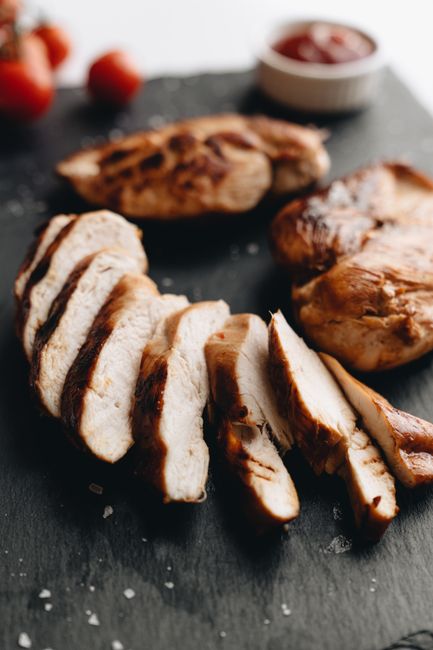
Chicken breast is done the instant the thickest part reads 165°F (74°C) on a quick-read thermometer inserted horizontally through the center — this is the USDA safe minimum, and because the meat is so lean, there is zero reward and real penalty for going past it. Pull at 162–163°F and let carryover heat finish the job during the 5-minute rest. Visually, the surface should be uniformly golden with no translucence, and the juices should run clear, not cloudy or tinged red.
Common mistakes
- Cooking to a timer instead of a thermometer. Two breasts that look identical can differ by 5 minutes; pull the moment the thickest part reads 165°F or you will dry out the lean meat.
- Leaving the breast unpounded. A natural tapered shape guarantees a dry, stringy tail and a raw center in the same piece — pound to an even ¾ inch.
- Skipping the thin oil coating. With almost no fat of its own, a bare breast scorches and the seasoning blows off; 1 teaspoon of oil or mayo carries the salt and triggers browning.
- Slicing immediately out of the basket. Cutting hot sends the juices onto the board; a 5-minute rest lets them reabsorb so each slice stays moist.
Serving Suggestions
Slice warm breast against the grain into ¼-inch strips for salads, grain bowls, or sandwiches — cutting across the fibers keeps each bite tender. Leftovers hold for 4 days refrigerated and shred cleanly for chicken salad or tacos. For a complete plate, pair it with a starchy side that soaks up the resting juices and add something green to cut the richness.
Pairs well with: Sweet Potato Fries, Broccoli Florets
Times and temperatures verified against USDA FSIS safe minimum internal temperatures and manufacturer cooking charts (Ninja, Cosori, Instant Pot Vortex). Every air fryer runs slightly hot or cool — treat these as starting points and adjust ±2 minutes to taste.
Chicken Breast (boneless) air fryer FAQ
Should I brine chicken breast before air frying?
Yes, if you have 30 minutes. Dissolve 1 tablespoon of kosher salt and 1 tablespoon of sugar in 1 cup of water, soak the breasts, then rinse and pat dry. The brine seasons the meat through and adds a real 4–5°F buffer before the lean fibers dry out — the single biggest upgrade you can make.
Why does my air fryer chicken breast come out dry?
Almost always overcooking. Pull the moment the thickest part reads 165°F on a thermometer — at 170°F the lean muscle fibers have squeezed out their juice and no amount of resting brings it back. Uneven thickness is the other culprit: the thin end is well-done before the thick end is safe.
Do I need to flip the chicken breast?
Yes, once, at the halfway mark. The basket's heat comes primarily from above, so the top browns faster. Flipping gives the underside direct radiant heat so both sides finish evenly and the bottom does not stew in its own pooled juice.
Is pink chicken safe if it hits 165°F?
Yes. Color is unreliable — a breast can read a fully safe 165°F and still show a faint pink tint near the bone, especially in younger birds. Trust the thermometer over your eyes. If the thickest part holds 165°F for even a few seconds, the meat is safe by USDA standards.